
Pillar
The Execution Gap: Where Strategies Quietly Die
The execution gap is the distance between what leadership decides and what actually happens across teams. It occurs when organizations lack the system to continuously reconnect daily work with strategic intent. The result: initiatives drift, priorities compete, and strategy dies in the space between the offsite and the operating reality.
Life is what happens to you while you're busy making other plans
Many strategies don't fail loudly. They don't collapse overnight. They don't trigger dramatic crises.
Instead, they slowly disappear in the space between strategic intent and daily work.
At first, everything looks fine. Teams are busy. Projects move forward. Meetings are held. Reports are delivered.
But gradually something subtle begins to happen.
Day-to-day efforts erode the strategy.
At best, the strategy slowly loses momentum. Teams focus on operational priorities, new ideas appear, and initiatives multiply. Everyone works hard, yet the connection to the strategy becomes weaker over time.
At worst, the situation becomes more personal. Finger pointing begins. The blame game starts. Eventually people start losing their jobs — even though the real issue was never clearly understood.
Very often, the real problem is what I call the execution gap.
What Is the Execution Gap?
The execution gap is the distance between what leadership decides the organization should achieve and what actually happens across teams.
On one side sits strategic intent: the direction and priorities of the organization.
On the other side sits execution: the work teams do every day to move the business forward.
The execution gap appears when those two worlds are not continuously connected.
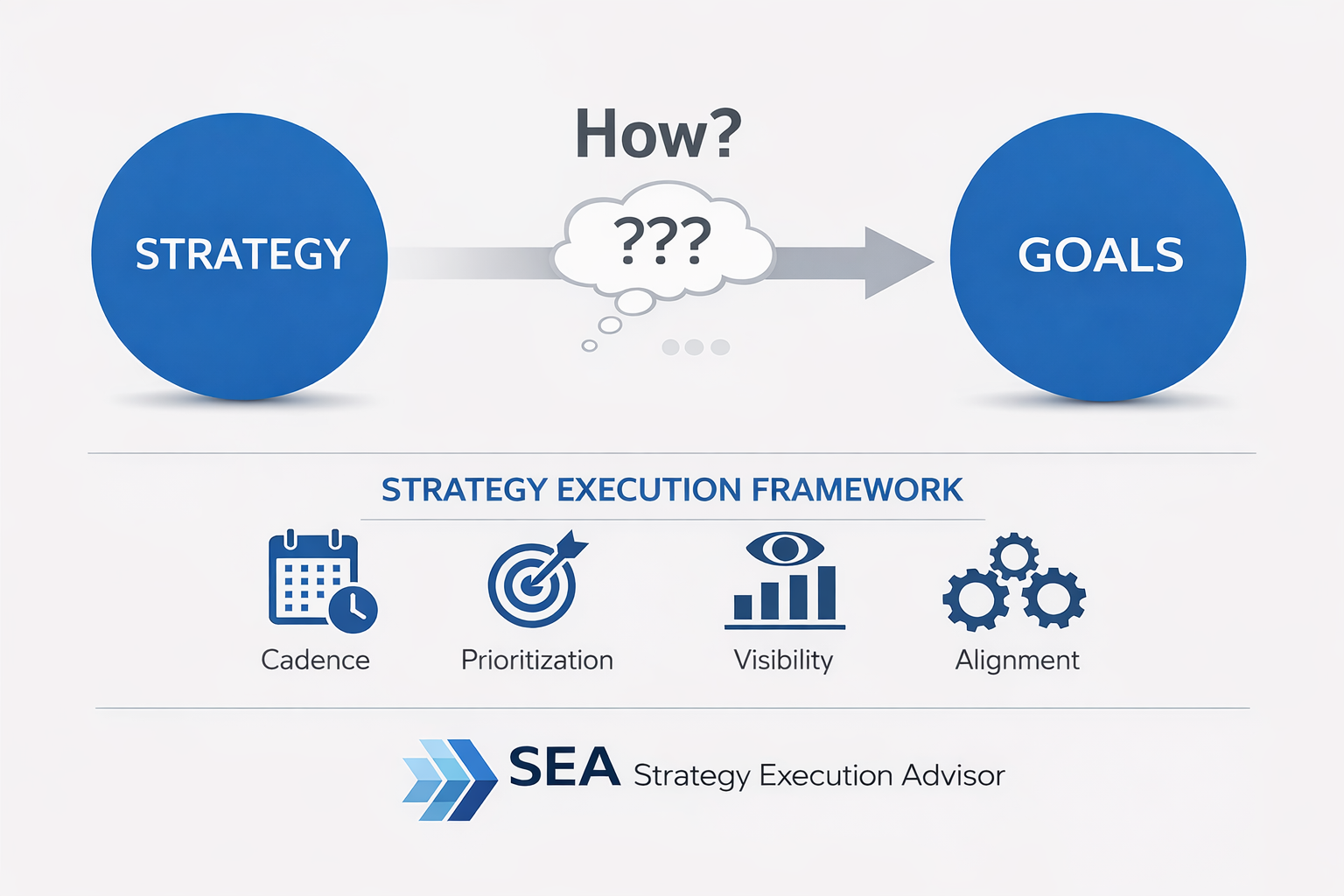
Strategy exists. Work happens. But over time day-to-day efforts erode the strategy, simply because no system reconnects execution with strategic intent.
Why the Execution Gap Appears in Most Organizations
Organizations are dynamic systems. New opportunities appear. Operational problems need solving. Customers demand attention. Teams start new initiatives to address immediate needs.
None of this is wrong. In fact, much of it represents healthy learning and adaptation.
But without a structure that continuously reconnects execution with strategy, day-to-day efforts slowly widen the execution gap. Learnings remain local, priorities drift, and frustration grows.
The organization becomes very active — but the key question remains:
Are we actually delivering on the strategy, or are we widening the execution gap?
How the Execution Gap Shows Up in Practice
The execution gap rarely appears as a dramatic failure.
Instead, it shows up as fragmentation.
Different teams move in different directions. New initiatives emerge across the organization. Local decisions make sense individually, but the overall picture becomes harder to connect to strategy.
From the outside, it can look like the strategy itself is flawed. In reality, the strategy is simply losing its grip on the organization's daily work.
Why Leaders Often Underestimate the Execution Gap
Most leaders sense that something isn't quite working.
Questions start appearing.
- Is this a people problem?
- Are we missing capabilities?
- Do we need better KPIs?
- Should leadership become more involved?
The natural response is often the same: more meetings, more reporting, more alignment.
But more meetings do not close the execution gap. In many cases they simply create more noise.
The real issue is not attention.
The real issue is that most organizations lack a structured leadership cadence for managing strategy execution and reducing the execution gap.
What Is Actually Missing
What is missing in most organizations is surprisingly simple.
- Not more strategy.
- Not more initiatives.
- Not more tools.
What is missing is a cadence of leadership decisions and prioritization.
Reducing the execution gap requires a system where leadership regularly:
- reviews strategic initiatives
- prioritizes resources
- resolves cross-functional dependencies
- adjusts execution based on learning
This is what the Strategy Execution Framework provides: the structural layers that close the execution gap systematically.
The Role of Leadership Cadence in Closing the Execution Gap
Closing the execution gap requires leadership teams to actively run strategy execution, not just define strategy.
This means establishing a structured cadence where leaders continuously:
- review progress against strategic priorities
- prioritize and reprioritize initiatives
- resolve cross-functional dependencies
- feed execution insights back into strategic decisions
The exact cadence can vary. Some organizations run weekly meetings. Others operate with bi-weekly or monthly prioritization sessions.
What matters is not the exact frequency, but the existence of a consistent rhythm, inspired by the iterative principles behind Scrum, applied to the strategic level.
When that rhythm exists, the execution gap begins to shrink and strategy remains connected to daily work.
Why OKRs Alone Do Not Close the Execution Gap
When organizations realize they have an execution problem, many turn to OKRs or similar goal-setting frameworks.
At first glance, that seems reasonable. Goals create focus. Measurement creates accountability.
But here is the uncomfortable truth:
OKRs alone do not close the execution gap.
Without the right leadership cadence and prioritization process around them, OKRs often become just another layer of goal-setting.
Strategy Execution Maturity
Organizations do not eliminate the execution gap overnight.
Instead, they gradually develop more mature ways of coordinating strategy and execution.
Some companies operate mainly with goals. Others introduce initiatives. The most mature organizations manage strategy through outcome-based goals, coordinated initiatives, clear prioritization, and structured execution rhythms.
If you have followed the reasoning so far, the natural next question becomes:
Where does your organization actually stand?
Because before you can close the execution gap, you first need to understand how large it is.
Take the Strategy Execution Maturity Assessment to find out.
Where does your organization stand?
Most leadership teams have some of these pieces. Few have them working as one system. A short conversation is the fastest way to see what is missing.
Book a 45-minute readiness conversation