Insights
Open Loop or Closed Loop Strategy Execution?
When designing a system, you can choose between an open-loop and a closed-loop system. An open-loop system operates without feedback—the output is not measured against the desired result. A closed-loop system uses feedback to measure, compare, adjust, and learn over time.
What Is Open Loop vs Closed Loop Strategy Execution?
In most organizations, strategy execution functions as an open-loop system. Strategies are carefully crafted, presented, and communicated. Yet months later, leaders are often unsure whether strategy execution is progressing as intended—or drifting.
This is not a new problem, but it is often misunderstood. The issue is not strategy itself, but the absence of a strategy execution system that enables continuous feedback and adjustment. Without this, organizations lack visibility into strategy execution as it happens.
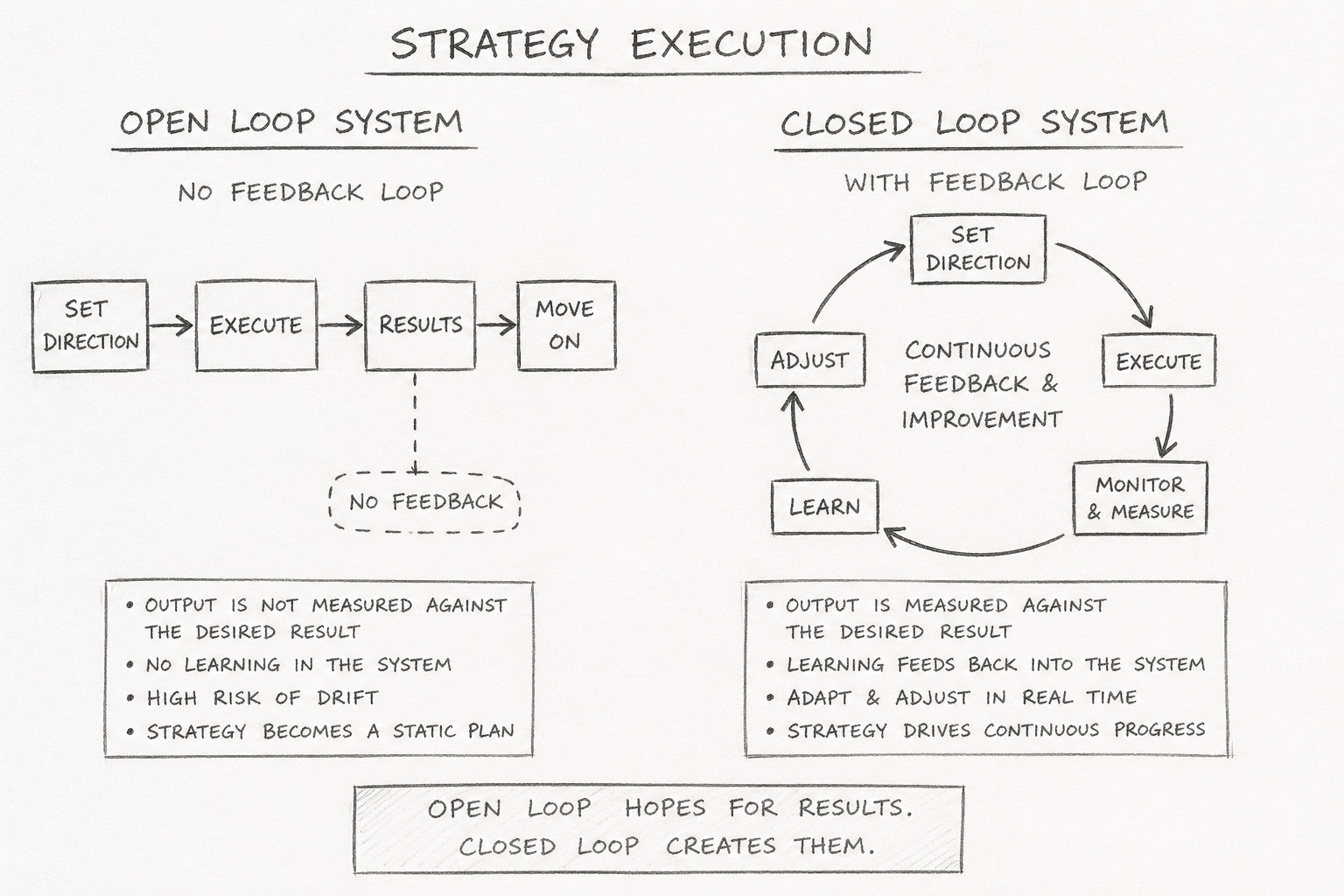
From Open Loop to a Closed Loop Strategy Execution Framework
A closed-loop approach addresses this. It connects strategy to execution through continuous measurement, evaluation, and adaptation. Instead of setting direction and hoping for results, it creates a structured cycle of learning and adjustment.
At its core, this system links:
- Strategy and direction
- Goals
- Initiatives
- Prioritization
- Continuous evaluation and learning
These elements operate in a defined cadence, where long-term direction is translated into shorter strategy execution cycles. The underlying logic is simple:
Set direction → Execute → Monitor → Learn → Adjust → Repeat
This is the practical foundation of a strategy execution framework. It embeds learning into strategy execution and makes progress visible before outcomes are finalized.
Benefits of Closed Loop Strategy Execution
The impact is straightforward:
- Strategy becomes visible in daily decisions
- Priorities are continuously reassessed
- Teams align around outcomes
- Learning becomes systematic
The shift from open to closed loop strategy execution is not about complexity, but discipline. It replaces assumption with feedback and creates visibility during execution, not after.
Strategy Execution in an AI-Driven Context
This becomes more critical in an AI-driven context. Increased speed of execution amplifies both strengths and weaknesses. Speed without direction has limited value. Combined with direction, it creates velocity.
Organizations operating in fast-changing, data-rich environments already know this. They rely on short cycles, constant measurement, and rapid adjustment—functioning as closed-loop strategy execution systems by necessity.
The difference between more traditional businesses is not subtle. One leaks value. The other compounds it.